

Though it may not seem possible, the future realistically holds the death of Google search traffic. Let’s look at some data to explain why this is likely to happen.
Google Becomes Alexa
Amazon has more than 10,000 employees working on the Alexa product, and they’ve sold more than 100 million Alexa devices. I know there are lots of people who refuse to use Alexa because they don’t want Amazon to have their data, but that’s not stopping the takeover.
Alexa is really good at providing a single answer to your question. Historically, Google has been really good at providing millions of answers to your question.
On a mobile device, if you type in “What is the capital of California,” you’ll get more than a billion answers. But if you type the same phrase into Google Chrome, the answer will appear even before you hit enter to execute the search. Why? Alexa.
In an article in Wired, titled “Amazon Alexa and the Search for the One Perfect Answer,”this paragraph stands out:
“The move toward one-shot answers has been just low enough to obscure its own most important consequence: killing off the internet as we know it. The conventional web, with all of his tedious pages and links, is giving way to the conversational web and which chatty AIs reign supreme.”
It’s simple. Google is shifting away from the business of delivering lots of answers and is instead moving to the business of delivering a single answer without requiring users to click.
If you type in “What is the capital of California” on a desktop in Google, you’ll see the answer at the top of the search results page, and therefore there’s no need to click. And in searching to find out how many Alexa devices were sold, the answer along with the link that it came from showed as a featured snippet on the top of the search results page. There was no need for me to actually click the link.
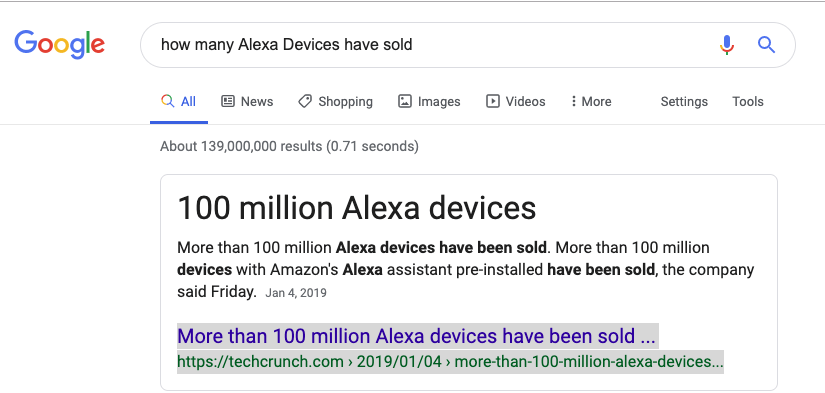
Why would anyone click those results if the answer is right there in front of them? What could this mean for businesses?
Google is doing everything it can to answer the question before any search results come up. you’ll find other phrases people search for, dictionary definitions, an overview of the search results with other links, more things people search for, and then the results.
Social Media Examiner decided to dig a little bit deeper to find out what this could mean for their company. In searching the phrase “social media”, They found their ranking is two or three depending on their day. Under mobile results, they found themselves on the top of the fifth screen.
When it came to the actual search results Wikipedia was first followed by an obscure site they’ve never heard of and then Social Media Examiner.
From there, they went into Google Search Console to find out how many people were searching the phrase “social media”. Google Search Console revealed that people search the phrase “social media” 1.43 million times over the last 90 days but less than 1% of those people clicked on the Social Media Examiner link. Their ranking position is around 6.
Wikipedia is no longer in the number one slot. Google itself is taking all of the top slots.
What this translates to is ranking first or second doesn’t really mean anything anymore since Google is taking those slots. Does this mean search engine optimization is becoming less relevant?
At this point, Google is only delivering answers to simple questions, so you may not think it really has much of an impact. However, data shows that nearly half of all Google search traffic does not result in a click.
When results like the one for my search on the number of Alexa devices sold show at the top of a search query, there is no longer any need to click through to the article that the snippet is sourced from.
When Social Media Examiner ran a test, they found their article on how to set up the Facebook attribution window was in the featured snippet for that search. The Google search console revealed that their article where is displayed more than 100,000 times over the course of the last 90 days but was only clicked on 4,658 times, or 4.6% of the time.
Google did not ask Social Media Examiner if they could feature the answer. They did not post any food in the contents provide the answer. Google use the content without permission bypassing possible traffic to the Social Media Examiner website.
In 2014, Google spent more than $500 million to purchase the AI company DeepMind. And over the last few years, Alphabet, Google’s parent company has purchased 38 AI-related businesses. As AI systems get smarter, they’ll be able to answer more complex questions and this should be concerning to you if you’re in the business of providing valuable information to your audience.
What Does This Mean for Us?
It means that SEO alone isn’t going to solve your issues. For most of us out there, and overwhelming source of traffic is from Google. In some cases, you may find the Google is not only your number one traffic Source but it’s also the top source of email subscribers. and for businesses where email brings the most Revenue, this could spell disaster.
In the future, we could see continuing declines in traffic because Google takes up the top slots for search queries. As a result, you have fewer people to nurture since there are fewer people actually reading your content, sharing it, and opting into your emails. Because of this, you’ll end up with fewer customers and your revenue will decline as your owned audiences shrink.
And because of this, you’ll have to spend more money with sites like Google and Facebook to grow your audience and market your products.
How To Handle This
Work on your conversion rate optimization. Understanding that you’ll be getting less traffic to your site means that you need to optimize the likelihood that new site visitors will become a newsletter subscriber or paying customers.
Beyond this, you’ll need to diversify your content so that it’s not just written words. Alexa and Google will never be able to answer on everything. Expert advice and opinions are always valuable and AI won’t be able to replicate that. This means you’ll need to increase your video and audio content over time. Invest in YouTube channel or start a podcast.
And while written opinions probably won’t ever rank in search, your readers actually want to know what you think about things so investing in this type of content is a good idea.
Here at Sachs Marketing Group, we can help you with conversion rate optimization and developing a content strategy that will work in concert with declining organic search. We can also help you optimize for voice search in the meantime.
The post What the Death of Google Search Traffic Means for Businesses appeared first on Sachs Marketing Group.
from Blog – Sachs Marketing Group https://ift.tt/2EBtcYU via IFTTT
Comments
Post a Comment