I’ve been fascinated with the rise of citizen developers in marketing empowered by a rapidly expanding landscape of “no code” tools for several years now.
Momentum is growing, and while there’s some philosophical debate to be had around what is or isn’t a “no code” tool — versus any app that lets you create things without breaking into raw JavaScript or HTML5 — there’s no denying that the capabilities that marketers have at their fingertips to build things today is extraordinary.
If the 2010’s were about the emergence of marketing technologists as a bona fide discipline within the marketing profession, then the 2020’s seem poised to deliver us into the age of the “marketing maker.”
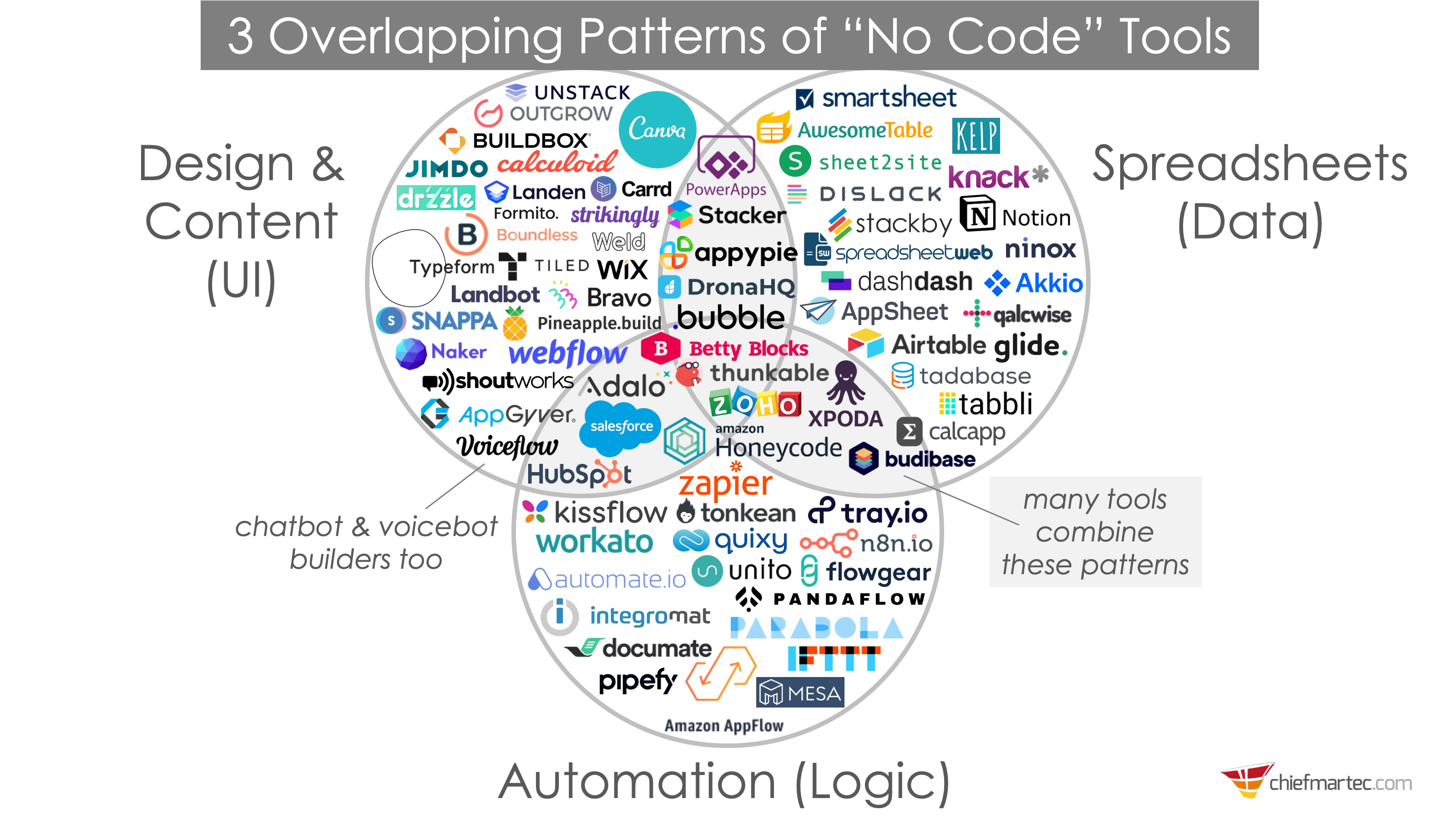
In looking at a lot of different no code tools — and there are a lot of no code tools out there now — I noticed that many fell into one of three “patterns” of how they worked:
- Design & Content (UI) — web and mobile app builders, bot flows, interactive content
- Spreadsheets (Data) — if you can use Excel or Google Sheets, you can build an app
- Automation (Logic) — workflow and integrations (iPaaS) with event-drive models
And, of course, there are no code tools that combine these patterns, giving you a lot of power and flexibility in what you can build. I think of Bubble as a quintessential example of such a combo.
The Venn diagram no code landscape above is a first attempt at visualizing a partial universe of those tools. (Usual disclaimer applies: this is only a representative sample and is definitely not comprehensive.)

(What can I say, Doug? Fish swim. Birds fly. I arrange logos on slides like a Martech Mr. Monk.)
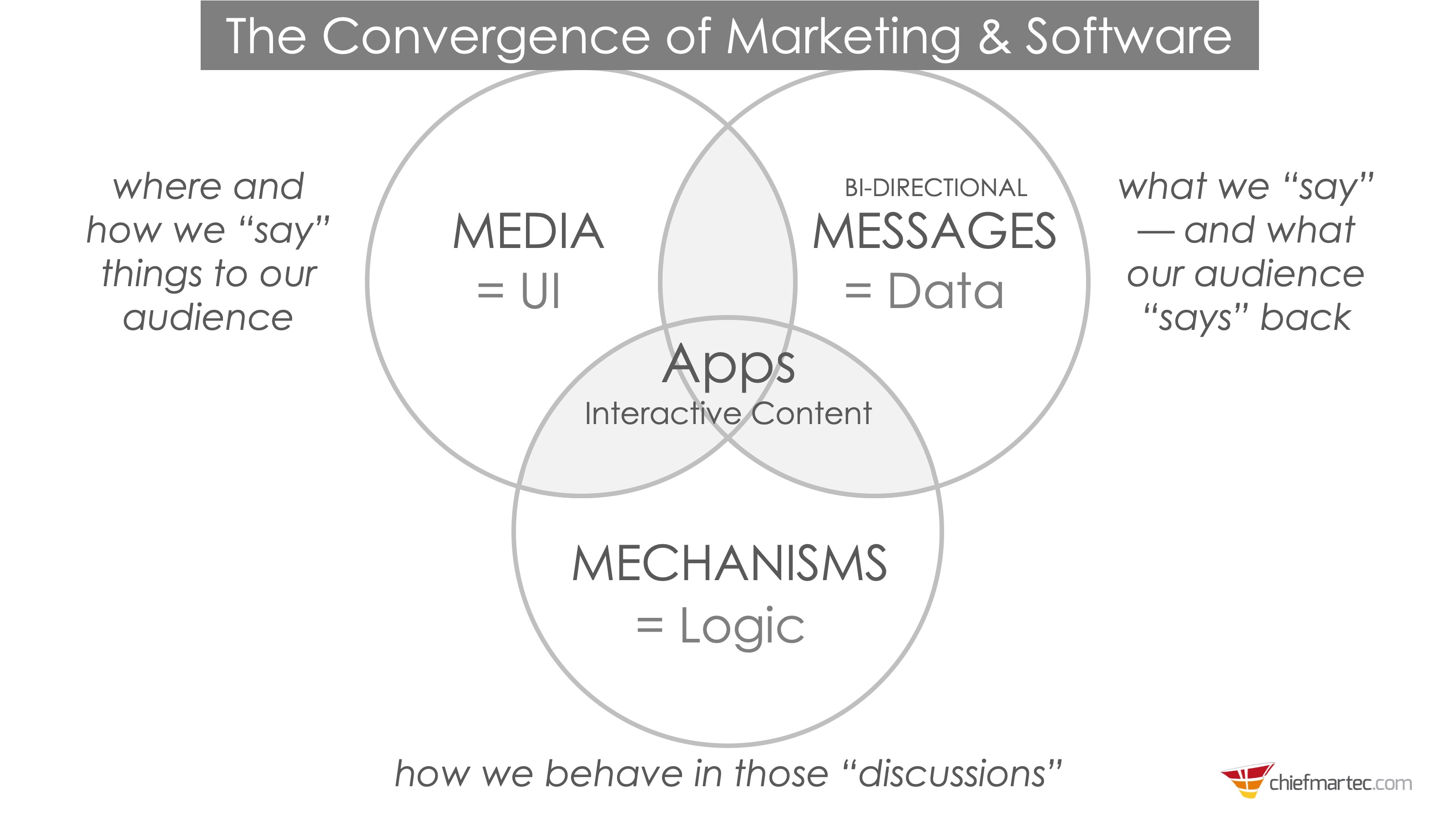
As soon as I drew this overlapping Venn diagram, it looked familiar. (Well, beyond the fact that all three-circle overlapping Venn diagrams basically look the same.) This is almost exactly the same model that I described in Hacking Marketing about media, messages, and mechanisms in marketing and their parallels with UI, data, and code (logic) in software development.
It turns out that’s a nearly perfect overlap with these no code categories too:
Probably not coincidentally.
Marketers have historically separated their work in the silos of the three M’s of media (paid, earned, owned), messages (including the “messages” from customers of how they react to the touches that marketers have with them), and mechanisms (apps and ops). So you can easily imagine no code tools that facilitated each of those missions. But increasingly these missions are being orchestrated as part of a greater whole.
It’s not just that marketers are using a lot more apps.
They’re also building a lot more apps too — if we can broadly label the output of all of these different no code tools as shades of “apps.”
The age of marketing makers = the appification of marketing content and operations.
(BTW, “apps and ops” is a great shorthand job description of marketing operations roles.)
I’d love to hear any feedback you have on this model. Or examples of similar no code tools that I missed. I realize there are other categories of no code tools that are adjacent to this model, such as self-service tools for data analysis and visualization. I also didn’t cover the vast array of “low code” platforms out there — Outsystems, Mendix, Quick Base, Appian, etc. — that still require a bit of coding to harness their power.
Beyond app building, what other apps come to mind in the spirit of no code — i.e., tools that give non-specialist marketers the ability to create things that previously only a specialist could deliver?
The post 3 overlapping patterns of “no code” martech and the rise of marketing makers appeared first on Chief Marketing Technologist.
from Chief Marketing Technologist https://ift.tt/3k816Z0
via IFTTT
Comments
Post a Comment