

It now seems like a lifetime ago. Shortly before the onset of COVID-19 and my joining Salesforce as the Global Innovation Evangelist, I flew to London to participate in an expert panel on software defined networking (SDN) and the future of digital transformation. While digital transformation itself has been disrupted in the time since, SDN, like many enabling and mission-critical technologies are more important now than ever.
I recently stumbled across unpublished material that I wanted to share with you here.
Insights from the insiders Join our expert panel as they explore the relationships between data, trust, talent and innovation. They’ll be considering questions that include: what emerging trends are disrupting the business landscape? How is data and personalisation being used to ‘wow’ customers? What does it take to be a disruptor? And what practices are empowering employees and affecting company culture? Click the play button to hear their insights.
Here are some of the highlights from the conversation…
How can we build trust in digital business?
We live and work in an era of ‘digital Darwinism’, where disruptive technology is rapidly evolving – and so are its effects on markets and society.
Over the past decade, ‘digital transformation’ has emerged as the driving force behind business’ ability to survive and thrive. The term has earned buzzword status way beyond the technology industry but make no mistake: digital transformation isn’t marketing hype – it’s a critical enabler of business modernization.
Making smart investments
In terms of business investment in digital transformation, cloud migration is high on the agenda. Comparatively, there’s little investment in modernizing network infrastructure and in software-defined networking (SDN). While perhaps not surprising, it is concerning. Because without this infrastructure, organizations simply can’t lay the right foundations to help information flow through their business. And in a digital economy, where information is currency, that’s a necessity.
A recent report from Vodafone Business discusses this topic further. It explores the role and importance of SDN, within the broader context of ‘Building Trust in Digital Business’. In today’s digitally-driven world, it’s a must-read for every business leader – here are some of my key take-outs.
The age of tech-enabled trust
Trust and transparency are critical pillars for modern brands hoping to engage always-on, always-informed customers. The good news is that, with the abundance of data that now exists, there’s a real opportunity to build trust through personalization, targeted services and tailored experiences, that can be delivered securely, in real-time. The bad news is that earning and keeping that trust is a huge responsibility.
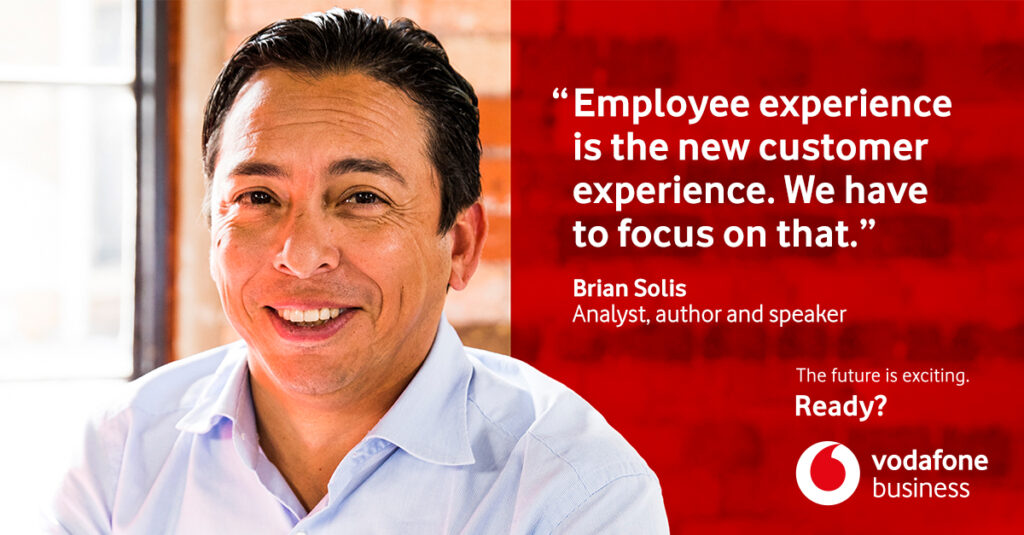
To nurture relationships, you must invest in customer and employee experiences. There can be no compromises. Businesses must be both transparent and human. The irony, of course, is that it’s technology infrastructure that enables and facilitates this humanity, and that also opens the doors to transparency and reciprocity. The lesson here? Work from the ground up.
A platform for the digital consumer
Going back decades, technology was largely an enterprise-driven endeavor: the onus was on consumers and employees to learn how to use workplace technologies. Now, the consumerization of technology has turned the tables. Its employees and customers now calling the shots, and the pressure’s on businesses to deliver the experiences they demand.
Actually, if you look at the top digital investments, they’re all focused on customer experience in some way – even infrastructure. Because, it’s the infrastructure that we flood, 24/7, with data, insights and traffic. And that’s what helps us to improve the customer journey and shape customer experiences.
So, like it or not, a seamless customer experience really is dependent, in part, on your infrastructure investment. Customers don’t care if you’re digitally transforming; they care about themselves. And they’re only loyal to those organizations that place them at the center of everything.
Data-driven empathy
So, how do you deliver the meaningful, personal and timely experiences your customers and employees want? You need to understand what they are doing right now – not what they did weeks or months ago. And you need to be able to act on those insights, fast.
Extracting that information calls for new, synergic teams that combine AI-powered machines and humans. Because, only machines can scour data, at scale, with the required speed and accuracy. And only humans can interpret and action those insights in an empathetic, meaningful way.
So, what now?
Without doubt, data has become a competitive advantage in attracting top talent and helping them thrive. It goes way beyond an argument for “yet another IT department cost center”: it’s an imperative.
Vodafone Business’ research demonstrates that the potential of digital transformation is tied to more than just ‘survivability’. Looking at the evidence, SDN is “the cloud” of infrastructure and paves the way for real business performance improvements and, ultimately, growth. Without doubt, it’s critical in enabling and accelerating digital transformation.
To learn more, read my foreword for the SDN report, “The Age of Tech-Enabled Trust.”
The post Building Trust in Digital Business appeared first on Brian Solis.


 from Brian Solis https://ift.tt/32cDbzs via IFTTT
Comments
Post a Comment