I recently talked with Benjamin Bloom, senior director analyst for marketing technology and emerging trends at Gartner, around a report he recently published on Marketing Technology Drivers of Genius Brand Performance. (There’s a summary of the report in a blog post Ben wrote, Few “Genius” Brands Successfully Integrate Best-of-Breed Solutions Into a Cohesive Martech Roadmap.)
“Genius” in this context is a Gartner-specific definition. They’ve developed the Gartner Digital IQ Index to benchmark the digital performance of brands relative to industry competitors. It supposedly measures “more than 1,250 data points across four dimensions of digital.”
You can see the rankings of the top 10 brands in a number of different industries, mostly consumer, here. (Cleverly, to see the rankings of brands below the top 10 — potentially yours — you have to become a Gartner client.) For example, here’s the ranking for speciality brands:
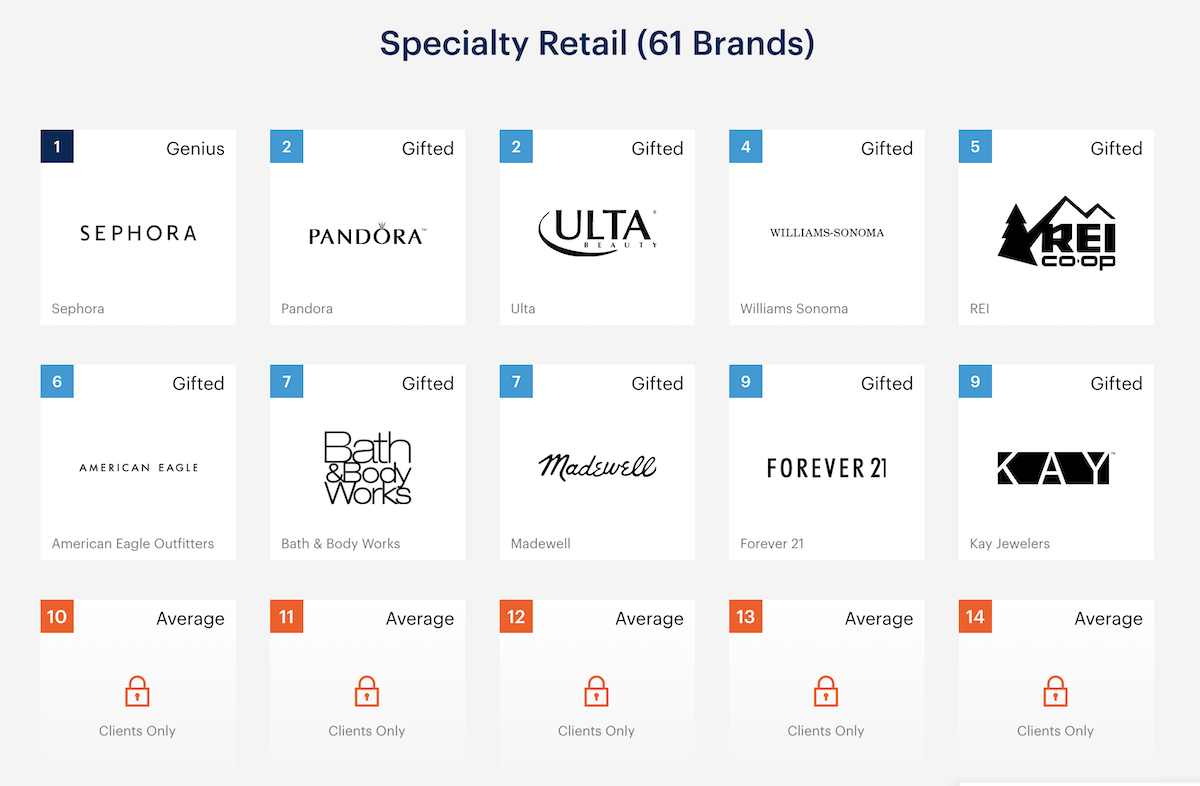
In Gartner’s ranking hierarchy, they label brands Genius, Gifted, Average, Challenged, or Feeble — from hero to zero, respectively. I’m not sure if their nomenclature was intentionally tongue-and-cheek, or if I just find it such. “Genius” and “Feeble” are a tad hyperbolic, no? On the other hand, I’m sure it stirs discussions, which can be a helpful catalyst for change.
Speaking of stirring discussion…
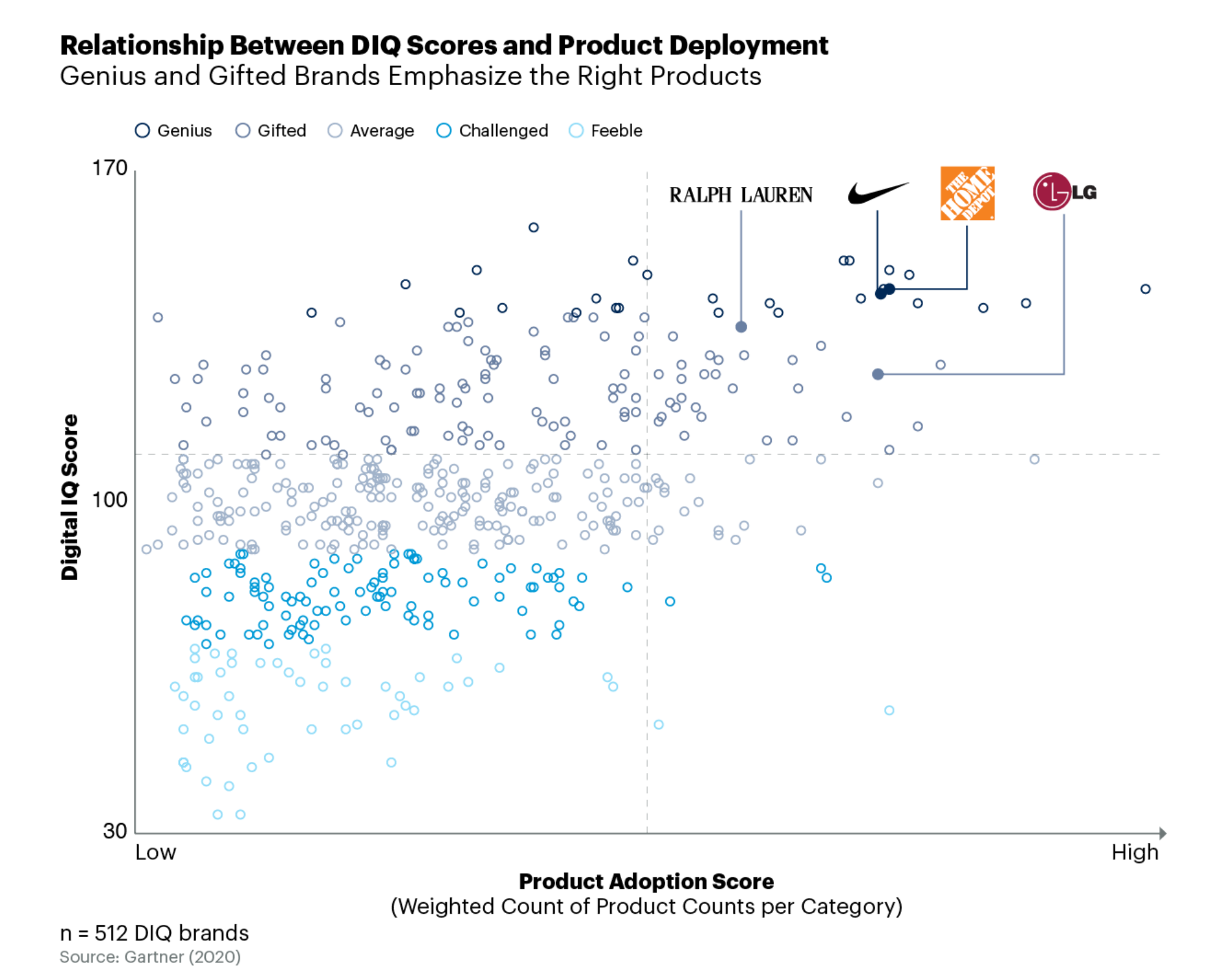
Ben’s report had a simple but brilliant premise: map brands on a two-dimensional graph by their Digital IQ on the y-axis and the size of the martech stack on the x-axis and see if there was any correlation. The resulting chart is at the top of this post.
Guess what?
It reveals a positive correlation between martech stack size and digital IQ.
Genius brands tend to have larger martech stacks, with 55+ products in them. Feeble and Challenged brands tended to have small martech stacks. It’s tempting to make the low-brow remark that, hey, when it comes to martech stacks, size matters.
But not so fast. First of all, stats 101 reminder: correlation is not causation.
Second, as with other things, it’s not just size. It’s in the way that you use it. (Sorry.)
There are plenty of Gifted brands, and a few Geniuses, in the upper left quadrant of the chart that have high Digital IQ and small or modest stacks. You also have a few Challenged and Feeble brands in the lower right that have large martech stacks but still suck wind, digitally-speaking.
Ben describes that lower-right corner as martech “sprawl.” A bunch of products in their stacks, but clearly not organized into cohesive digital business capabilities. He labels the upper-right corner above it — lots of martech, but high Digital IQ — as “complexity.” These are complex digital operations. But they’re extremely effective.
This is an insightful distinction. Martech sprawl is unquestionably bad. But martech complexity isn’t necessarily a bad thing. In fact, it may very well be integral to the competitive advantage that these brands wield.
Best-of-breed stacks for best-in-class brands.
And these are best-of-breed stacks. To quote Gartner’s report (emphasis added is mine), “Genius brands do leverage technologies from [large martech suite] vendors, but point solutions account for nearly three-quarters of the technologies in their stacks. By comparison, less-savvy brands have a greater share of products from [larger] martech vendors among their portfolios.”
But these high Digital IQ brands manage the combination of major martech platforms and specialized point solutions in a highly disciplined fashion. They methodically collect and document uses cases, and they measure deployment and adoption of new martech tools against their impact on company revenue.
Of course, there’s plenty to debate here — and enough ambiguity in the data to serve as fodder for such disputes. We can “take it outside” to LinkedIn or Twitter, if you like.
For the record, my view is:
- A version of Occam’s Razor applies to martech: the simplest effective stack is best — but no simpler. Advantageous complexity, well-managed, can be a source of competitive strength.
- Point solutions integrated around a common platform are better than point solutions isolated in silos. (Yes, I’m biased on that view.)
- All the martech in the world won’t help you, if you don’t have a great product or service, if you don’t treat your customers well, or if you don’t hone your craft of great marketing on top of these technology-powered capabilities.
What do you think?
The post The larger your martech stack, the better your marketing performance? Maybe appeared first on Chief Marketing Technologist.
from Chief Marketing Technologist https://ift.tt/3apUVe8
via IFTTT
Comments
Post a Comment