Integration is by far the most important criteria when selecting martech — and it’s changing the industry
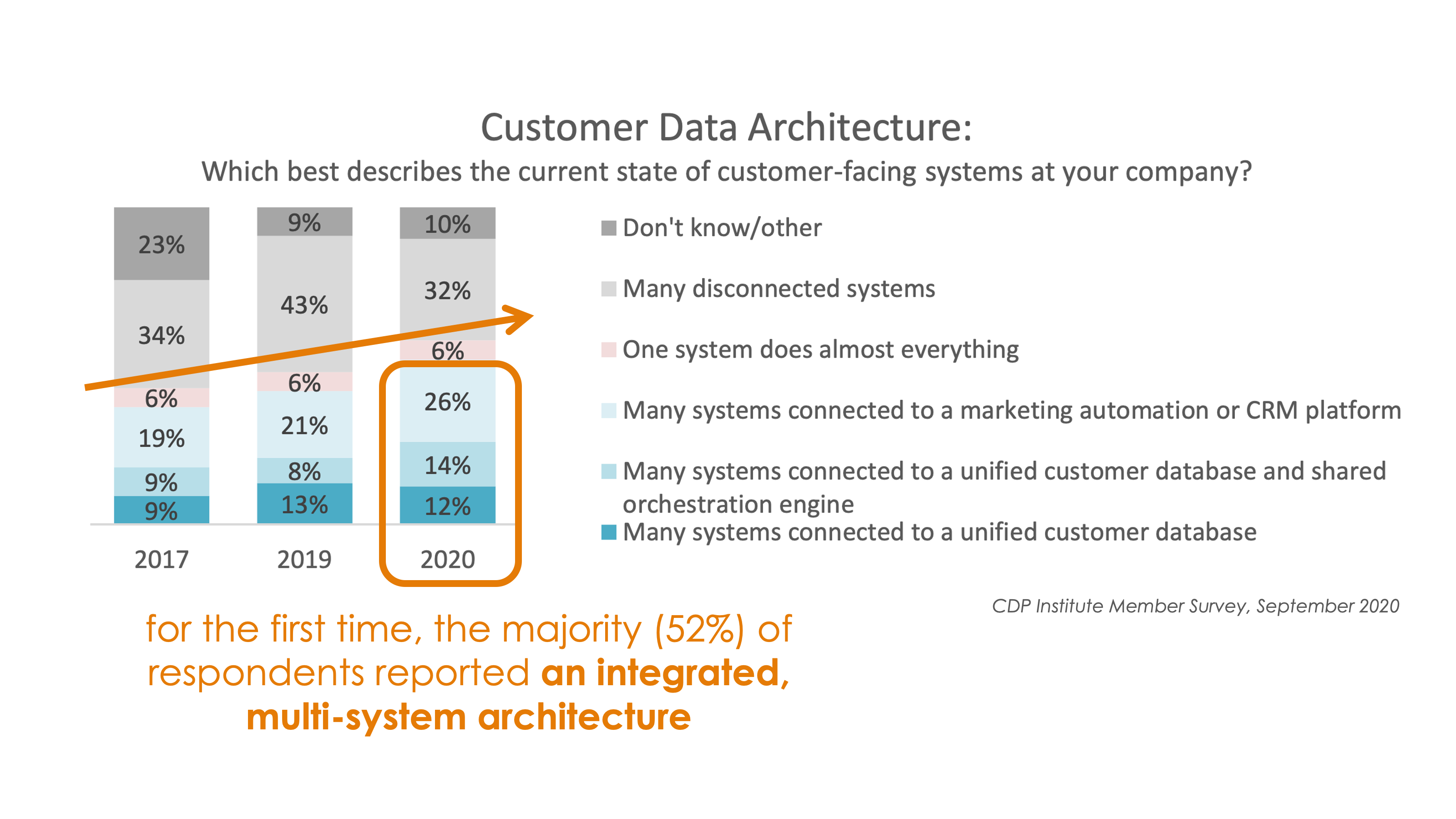
The CDP Institute released their latest State of Customer Data report last week, and it revealed an important milestone in the martech industry:
For the first time ever, the majority of participants (52%) described their martech stack as an integrated, multi-system architecture.
In others words, most marketers reported having a best-of-breed stack — with many products from many different vendors — but an integrated stack, so that these different apps were sharing data with a common system of record (a CDP, CRM, or marketing automation platform). For many of them, they had also connected an explicit orchestration engine or an implied one with a marketing automation platform.
Now, you might expect members of the CDP Institute to be generally ahead of the curve on martech best practices for multi-system integrations. After all, why else would they be there? Don’t most members of golf clubs play golf? But there’s a difference between being interested in CDPs and actually having successfully implemented a fully integrated stack.
In the 2017 report, only 37% of CDP members reported having an integrated, multi-system architecture in place. (And I’m going to make the assumption that marketers who had joined the CDP Institute three years ago were particularly ahead of the curve, as it was still a cutting-edge concept at the time.)
A few years later, integrated stacks jumped from 37% to 52%.
That’s a good sign that our industry is making progress. “Integration” has been the top pain point for marketers for pretty much the entire history of the marketing technology landscape. Marketers love their best-of-breed tools, but they were perpetually frustrated that those tools didn’t get along. It was like going to dinner with two of your best friends, but they can’t stand each other and spend the whole evening alternating between loud bickering and sullen silence.
The thing is: this was always a solvable problem. Martech vendors could invest their R&D dollars in integration as easily as any other feature dreamed up on a whiteboard. Leading vendors in the space could choose to open up and become true platforms as a core tenet of their strategy. If you’re looking for meaningful points of differentiation, depth of integration is a wide axis of possibility.
What actually forced the issue was that customers have finally drawn a line in the sand: if it doesn’t integrate, we’re not going to buy it.
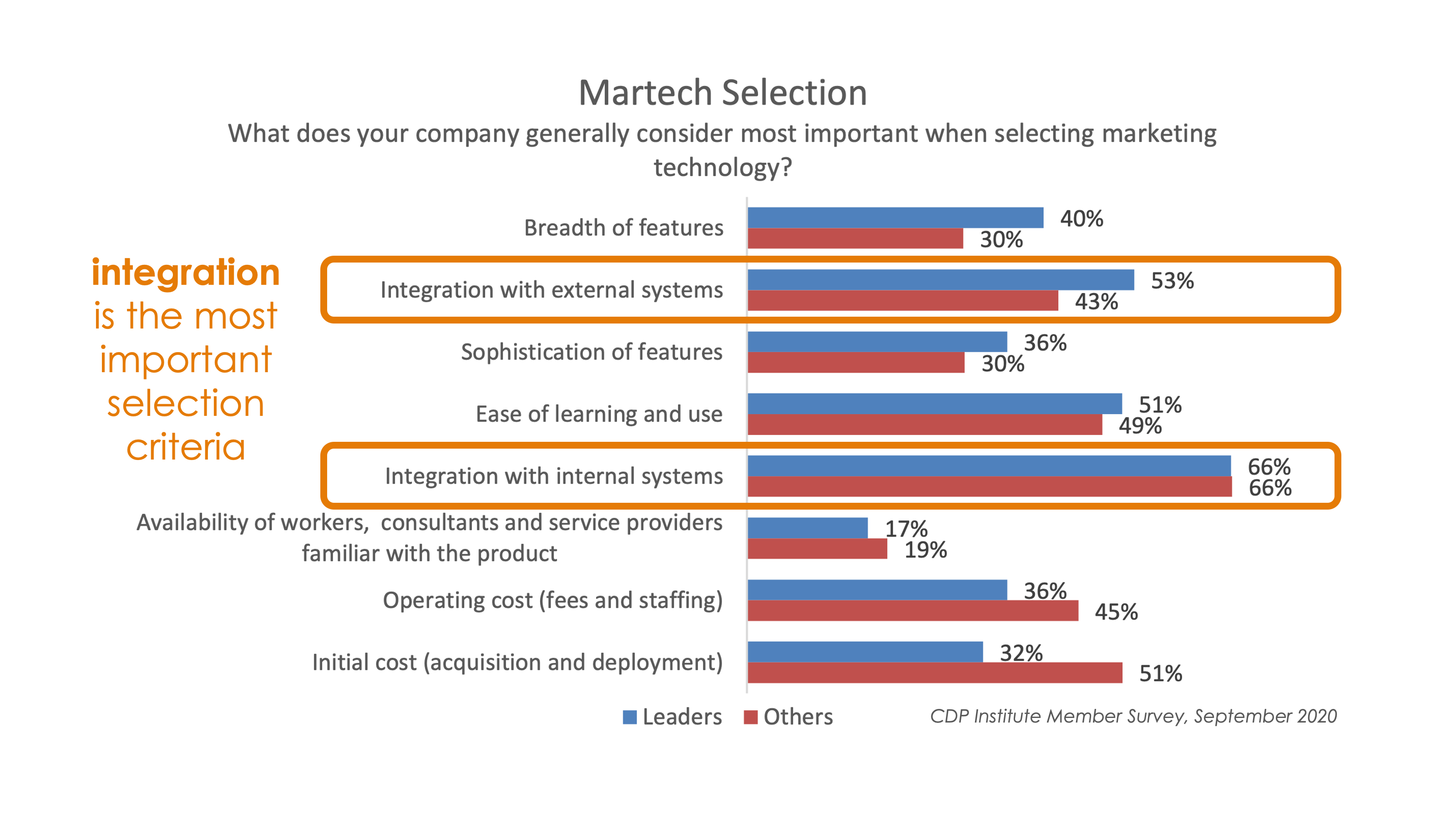
Indeed, one of the findings from the CDP Institute’s report what that, among the various is the criteria that companies consider most important when selecting marketing technology, integration is by far the most important.
It’s more important than price.
It’s more important than operating cost.
It’s more important than breadth or sophistication of features.
It’s even more important than ease of use — although that’s next most important.
The distinction between “leaders” (in blue) and “others” (in red) in the above chart from the report (annotated in orange by yours truly): leaders all reported an integrated architecture, above-average privacy management, and a relatively high satisfaction score overall with their martech systems.
But whether you’re a leader or aspire to be one, integration is still the #1 criterion.
If you’re a martech vendor, and you were waiting for a sign from the heavens about where you should focus on improving your product, the angels are speaking.
P.S. Want to hear more about the remarkable findings in this State of Customer Data report? Watch last week’s episode of The Martech Show: Insights from the CDP Whisperer with David Raab, founder of the CDP Institute (and the entire CDP movement for that matter).
In addition to excellent research on martech and CDPs, he also brought puppets:
The post Integration is by far the most important criteria when selecting martech — and it’s changing the industry appeared first on Chief Marketing Technologist.
from Chief Marketing Technologist https://ift.tt/3i9982a
via IFTTT
Comments
Post a Comment