The latest version of Apple’s operating system iOS 14 arrives with us next week. It had been set to fundamentally change the digital marketing industry due to the changes it was going to implement around IDFA (Identifier for Advertisers – the only way to track users within apps on iOS).
While those changes are no longer coinciding with the arrival of this update, Apple has stated they will still be coming to devices at some point in the near future. So what are the changes, why do they matter to the digital marketing industry, and what is it likely to mean for you?
Data as currency
The Internet may look free to use, but there is a currency that pays for everything. Data. Your data. For as long as the Internet has been around it has been funded by advertising and over time that advertising has become more and more sophisticated as we are able to collect ever more data about users and use it to target individuals in ever more specific ways. This targeting is based on who they are, what they’ve done online, what they might be interested in and so on. As things have evolved, the value of our data has increased and advertisers have become willing to pay a premium in order to access this information so they can target us online. Companies like Google and Facebook have built their entire businesses on this and made billions in the process.
However, it will come as no surprise to many that most people don’t like ads. A recent survey shows that 74% of people actively do what they can to avoid ads whether that is by paying for content, using an ad blocker or changing the way they consume media. Where a lot of recent privacy protection has fallen short is that much of it requires active effort from consumers, whether that’s by changing browsers, digging into your phone settings, or trawling through a cookie banner to minimise your exposure. It’s not easy, or convenient. And so the status quo continues.
What made these coming changes from Apple so seismic isn’t that it was new. These changes to IDFA have been in iOS for a while, hidden away in Settings. What’s different about it now is how Apple is finally living up to its claim to be privacy-focused by putting this box in front of every user who boots up an app that wants to track them using IDFA:
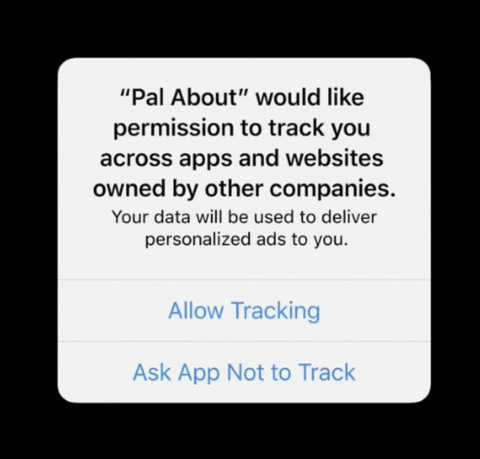
Who is going to click “Allow Tracking”? I wouldn’t. Would you?
The impact on the industry
We know these changes are significant because Google and Facebook are worried about them. Facebook attempted to rally developers by telling them how it would likely affect their income. Google, which has its own operating system through which it could continue to collect data has publicly appeared to go along with things, offering advice to developers on how to be compliant. However in the background, they’ve been reportedly telling advertisers to switch away from using Target ROAS as a bid strategy for UACs, since Google would no longer be able to collect the post-install data it needs to feed the algorithm.
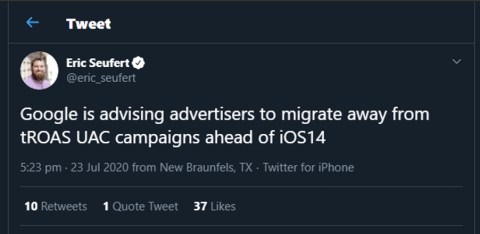
https://twitter.com/eric_seufert/status/1286336053117440002
The good news for the industry is that Apple announced last week that these changes won’t be coming with the roll-out of iOS14 in September. Instead, they’ll be coming In early 2021. So there is respite, but it’s only temporary.
All of this is happening against a backdrop of, at least in the EU, wider regulatory privacy changes, that could have even more far-reaching impacts on the digital marketing industry and the very existence of things like the humble cookie.
Similar to other big changes of recent years, such as mobile-first indexing, we have more time to figure out a way forward than we initially anticipated. We should be sure to use this time wisely!
If you don’t operate an app, it may be hard to see how this could impact you as a marketer. But consider for a moment how large the Apple install base is (in January they reported over 1.5 billion active devices). That data is used to help build out audience profiles – there’s a chance that the systems we use to power our campaigns could become less useful as a result. It could also mean less available ad inventory. In their post, Facebook implies that it may not be worth them running the Audience Network on iOS devices anymore if this goes ahead – so we’ll have advertisers competing for fewer inventory slots, which means potentially higher prices for everyone.
The other consideration is the knock-on effect that something like this can have. As we saw with the scandal over Cambridge Analytica, users were shocked to find out how their data was being used – although it was open knowledge to anyone who worked in the industry. What this will likely awaken is an appetite for more easily implemented privacy changes – and Apple with their market share and existing stance on privacy are very well-placed to benefit here. When Apple and Mozilla introduced enhanced privacy controls in the Safari and Firefox browsers, Google was forced into following suit. We could see a lot of the digital marketing ecosystem that we’re used to falling down like a row of dominos in the next few years, as this issue becomes increasingly important.
What’s next?
Ultimately, if you operate an app, you’re going to have to be compliant if you want to continue to thrive in Apple’s ecosystem. (Just ask Fortnite how it goes if you try and bend the rules.) If you don’t operate an app, then we’re very much having to wait and see what big platforms like Google and Facebook do in response.
What everyone can do though is start to be aware of, and plan, for how these wider industry changes will impact you. If we are no longer uniquely able to identify users when the E-Privacy Regulation comes into force, Apple’s changes to IDFA will be the least of our concerns. It could mean the end of cookies, IDFA and any technique that helps us track users, such as browser fingerprinting.
Start asking yourself questions about what your digital marketing would look like if you couldn’t track it to the same extent. What if you can’t identify relevant users in the same way? Rather than just looking for workarounds which would breach the spirit (and maybe even the letter) of the law of these new regulations, go back to basics and come up with alternative plans. Think about your KPIs – do we need to think about digital in a way more similar to TV and other offline activity that we can’t measure as directly? We don’t have all the answers for you – but it’s food for thought.
We recommend reading up on contextual targeting 2.0, and ways to be less focused on user demographics. Also, learn about the E-Privacy Regulation – while we can hope for the best, we can certainly plan for the worst. As users continue to become more digitally savvy and as they start to understand the value of their data, we’re only going to see this trend accelerate – and so our job as marketers and agencies is to help our clients be at the forefront of whatever the change may be.
The post iOS 14 and IDFA: What You Need To Know appeared first on Hallam.
from Blog – Hallam https://ift.tt/3bOAAjB
via IFTTT
Comments
Post a Comment