
 If you’re new to the world of digital marketing, you’ve probably been hearing some lingo and acronyms that you’re not familiar with. Things like SEO and PPC and CRO – all of which are very important to successful online marketing, but involve a bit of in-depth learning and understanding to fully grasp.
Before you delve into those acronyms, or become overwhelmed by the concepts they represent, there’s one very basic acronym that you’ll want to understand. One that’s a lot simpler and less abstract than those listed above:
CMS.
Here, we’ll delve into the basics of what a CMS is and why you need to care about it if you’re looking to market your business or organization online.
What is a Content Management System (CMS)?
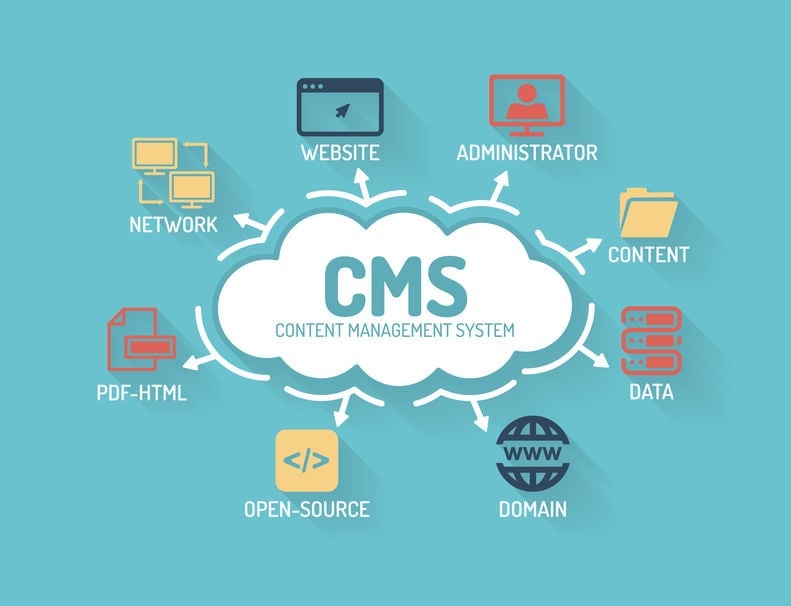
CMS stands for content management system. A content management system is the software you use to organize and update the information on your website.
You have probably heard of a variety of different content management systems, perhaps without realizing what they were. If you’ve heard of SquareSpace, Wix, Weebly, or WordPress, then you’ve heard of a CMS.
Why Do Content Management Systems Matter for Online Marketing?
If you’re marketing your business on the internet, one of the most important tools you’ll use is a website. And a website is built on a content management system.
As a result, you’ll rely on a content management system to create, maintain, and manage what’s on your website. You’ll likely become very familiar with the CMS you’re using, especially if you’re updating your website on a regular basis (which you should be doing!). For this reason, an easy-to-use CMS is key!
Content management systems also matter from a search engine optimization (SEO) perspective. If you want your business to be found online, you’ll need your website to rank well in the search engines for the terms that people are using to find businesses like yours.
Websites built on SEO-friendly content management systems have a better chance at ranking well in the search engines. When it comes to choosing a platform for your website, this is something to keep in mind as well.
What CMS Does Mannix Marketing Use?
When we build websites for our clients, the content management system we use is WordPress. We have decades of experience exploring content management systems, and WordPress is our CMS of choice for a number of reasons.
For one thing, WordPress is one of the most user-friendly content management systems out there. It’s one of the most popular website platforms available – and for good reason! Our clients can update their content, add pages, publish blog posts, and upload photos frustration-free because the WordPress interface is so intuitive and user-friendly.
(For those clients that don’t want to manage their websites themselves, or for those who run into challenges along the way, we provide ongoing client support. We’re here to assist with updates and edits anytime you need us.)
For another thing, WordPress is an SEO-friendly platform. Within WordPress, our team can build sites that look great and appeal to your target audience, but also perform well in the search engine results. The sites we build are responsive (meaning they present beautifully on tablets, desktops, and mobile devices), they’re fast-loading, and they’re designed to outperform your competitors in terms of search engine optimization. This means our WordPress websites can help your business get found online!
Ready to Build a Website in a CMS You Can Trust? Work with Us!
We have decades of experience building in WordPress, and we know what it takes to set your business up for success online. If you’re looking to showcase your company with a website built on a user-friendly, SEO-friendly content management system, we can help!
Get in touch with us today by calling 518-743-9424 , or contact us online to schedule a meeting to learn more about building a custom WordPress website for your business.
Interested in learning more about those other acronyms we mentioned earlier? Here are a few places to start when it comes to understanding the basics of digital marketing:
What is Search Engine Optimization (SEO)? – A quick general overview of what it means to create a website that is optimized to perform well in the search engines.
What is Pay Per Click (PPC)? – A short explanation of pay per click marketing.
What is Conversion Rate Optimization (CRO)? – A look at what conversion rate optimization is, and how you can improve the conversion rate for your business’ website.
The post What is a Content Management System? appeared first on Mannix Marketing, Inc..
from Blog – Mannix Marketing, Inc. https://ift.tt/33byOF9 via IFTTT
Comments
Post a Comment