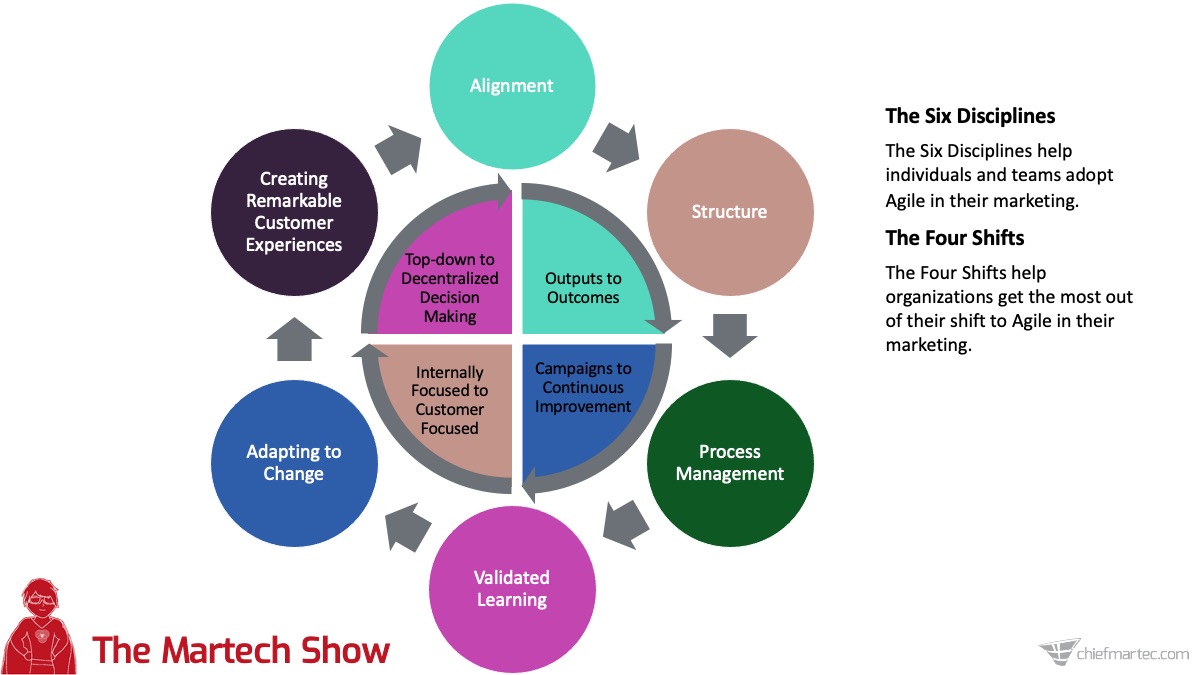
For the fifth episode of The Martech Show, we talked about five major trends of marketing technology. For this sixth episode, we discussed the six disciplines of agile marketing. For the seventh episode, we’ll clearly need to cover seven swans-a-swimming, which would make a great viral TikTok video.
Coincidence or martech numerology? You decide.
Seriously though, this episode was one of my favorite. Jim Ewel, one of the pioneers of agile marketing, just released a terrific book, The Six Disciplines of Agile Marketing, and he gave us an excellent overview of those disciplines and four shifts in management and culture that make agile methods really deliver.
We also took a brief trip down memory lane to a post I wrote over 10 years ago, sketching out early ideas for an agile manifesto. It’s pretty wild to think back to those younger days when the reconfigured blend of marketing, technology, and management was so nascent.
This past decade has taught us so much. Jim’s distilled so many of those learnings based on years of running agile teams and coaching and training others.
Here’s the full episode:
I highly recommend picking up a copy of Jim’s book.
Jim gave me the great honor of writing the foreword, which I’ll share with you here as a further temptation for what’s inside…
Foreword to The Six Disciplines of Agile Marketing
It has never been a better time to be a marketer.
The explosion of technology over the past 20 years has opened a myriad of new ways for us to attract, engage, and delight customers. Thousands of martech software companies now vie with each other to empower us in ever more innovative ways. Social networks and search engines give us near unlimited reach.
The digital world has become an unbounded canvas for us to create and communicate, drawing upon a palette of infinite shades and hues with an artists toolbox of every imaginable brush, knife, sponge.
And this power to create has never been in greater demand.
Marketing, which used to be a peripheral function at many companies — the “arts and crafts department” as one marketer once lamented to me — has gravitated to the very center of the organization.
Marketing has become the heartbeat of customer experience, delivering customer engagement to the far reaches of the organization and bringing rich insights back to the management brain.
Those who master the art and science and engineering of modern marketing can have the world at their feet.
And yet.
And yet many organizations struggle to harness this awesome creative power that is tauntingly just beyond their grasp.
It’s not because they can’t afford it. Many of the best tools in marketing today are relatively inexpensive, especially just to give them a try — the ubiquitous “freemium” model of software-as-a-service (SaaS). Nearly everything in the cloud scales on demand, so you can pay relative to the growth you achieve.
It’s not because they don’t have the skills — at least not the skills to wield the tools or execute digital tactics. Most of digital marketing isn’t rocket science. Martech tools are competing mightily with each other on user experience (UX), striving to make their products easier and friendlier for new users to adopt and apply.
And almost any question you have about how to do something can be answered instantaneously with a search on Google, which you can do from your glowing mobile phone in the middle of the night.
When you stop to think about it, we really do live in the age of miracles and wonders.
So where is the struggle? What stands between most marketing departments and digital paradise?
Management.
Of course, right? Who else takes the rap when something doesn’t work?
But the problem here isn’t the people in management. The problem is the process. Too many organizations still manage marketing with the practices and procedures of the previous century. It’s like yoking six horses to a jet airplane, so you can roll across the plains in a shiny, metal stagecoach.
To soar, we need a new approach to running marketing.
That approach, in a word, is “agile.”
The discipline of agile management has evolved over the past two decades, from a manifesto in software development circles to a rich set of methodologies that are now harnessed in nearly every discipline in our digital world. When applied in marketing, we call it “agile marketing.”
Agile marketing is the secret to splitting the digital atom and unleashing its full power.
Agile marketing enables your teams to move faster and more efficiently. They’ll adapt to changes better, with less friction and fuss. They’ll experiment in a focused and disciplined manner to discover new opportunities. They’ll continually improve — not just the work that they deliver, but the way they work together.
They’ll love their work more. Really.
In study after study, teams who have embraced agile marketing report that they enjoy their jobs more. Happy, empowered teams produce better results.
Unlike splitting the real atom, splitting the digital atom with agile marketing doesn’t take a PhD in particle physics. The principles of agile marketing are actually quite intuitive in the age of digital work, and its methods are mechanically quite easy to execute.
But implementing agile marketing successfully — not just speaking the words or going through the motions of stand-ups and Kanban boards — requires an understanding of the whole that is greater than the sum of its parts. It’s a hill to climb not because it’s inherently difficult, but because it’s different than how you’ve managed before.
But in your hands (or on your screen) is the guide you need to make that climb.
Jim Ewel is one of the pioneers of agile marketing, who helped forge the discipline over the past decade. He brings a wealth of experience as a marketing executive, a CEO, a university instructor in digital marketing, and an agile workshop leader for top brands. He has thought very deeply about the “how” and the “why” of agile marketing and has distilled his wisdom eloquently into this book.
The Six Disciplines of Agile Marketing is modern classic of marketing management.
Read this. Embrace it. Practice it. Iterate and adapt it.
On the other side, you’ll agree: there’s never been a better time to be a marketer.
The post The Martech Show Episode #6: The Six Disciplines of Agile Marketing appeared first on Chief Marketing Technologist.
from Chief Marketing Technologist https://ift.tt/2J1pfSJ
via IFTTT
Comments
Post a Comment