“Half the money I spend on advertising is wasted; the trouble is I don’t know which half” – John Wanamaker
Sounds familiar? Though coined over a century ago, this phrase remains painfully true today. Especially when it comes to complex buying processes like B2B transactions.
Believe it or not, over a third (34.1%) of businesses admit they don’t use any attribution model to measure marketing performance.
Simultaneously, only 13% of B2B marketers consider the impact measurement and tracking capabilities of their business excellent, with 40% describing their business as “needing improvement.” In the data-driven marketing world of 2020, this should no longer be the case.
We don’t need to tell you that B2B buyer journeys are rapidly migrating to the digital realm in the “new normal” of 2020. With that, dwindling marketing budgets are pushing businesses to optimize measuring the effectiveness of marketing and advertising efforts.
Numerous attribution models exist to help you discern which channels, platforms, ads, and types of content contribute to the conversion of a lead. But how can a marketer begin to choose? How can you pick the best approach to truly and effectively gauge the value of each interaction with the prospect?
Before you consider what attribution model is right for your business and strategy, it’s worth taking the time to understand and differentiate the most common B2B attribution models in use today.
Single-touch vs. Multi-touch attribution
Overall, there are two types of attribution model types: single-touch attribution and multiple-touch attribution. As the name suggests, one type credits a single point while the other distributes the credit between multiple points of interaction with the buyer in your funnel. 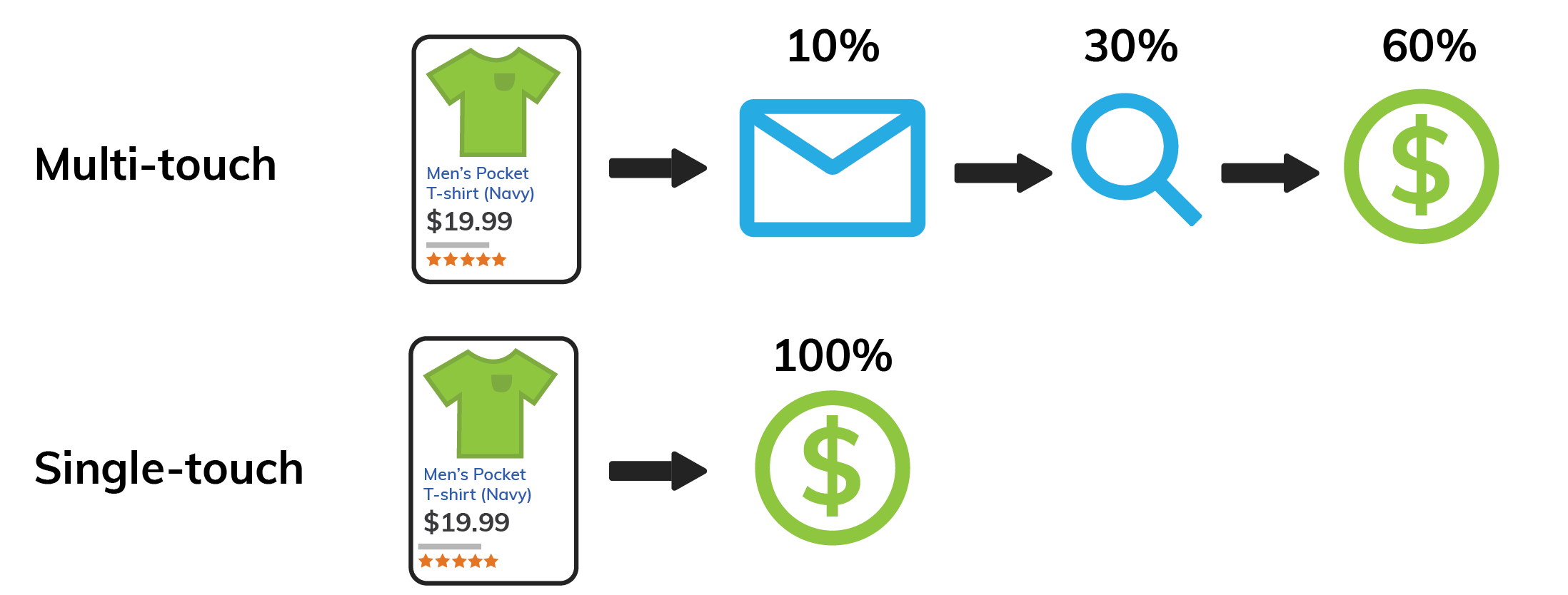
Single-touch attribution models are split primarily into first-touch and last-touch attribution, allocating the credit entirely to the first or last interaction with the prospect or lead.
Multi-touch attribution models offer a more holistic view of your buyer’s journey. With multi-touch models, you can assign a percentage of the credit for the conversion to any touchpoint along the buyer journey or funnel.
Why single-touch models are irrelevant for B2B
Single-touch models are simple and easy, but are also deeply flawed. They aren’t applicable to most funnels today because a typical b2b buyer passes at least 28 touchpoints in their journey to becoming a b2b customer . Trying to attribute the KPI based conversion to any single touchpoint will lead you to neglect other, perhaps more impactful, interactions with your prospects.

Understanding this, marketers created multi-touch attribution models of varying types to credit each touchpoint in the most accurate way possible. Among models popular today you will find time decay attribution, position-based attribution, linear attribution, and data-driven attribution. Each has a slightly different approach to how credit is distributed, but all have a similar goal: discovering what channels, campaigns and platforms merit additional investment.
The new B2B buyer journey
In 2020,, the number of B2B digital touchpoints has grown significantly, and not only due to COVID-19. Increasingly, decision-makers in organizations today are digital natives. 73% of all B2B purchases for companies directly involved Millennials, and nearly 40% of those were the sole decision-makers for their team.

In addition, over 40% of millennial workers preferred social media as the preeminent channel for researching potential product and service purchases. Over half of those said that digital channels were preferable over colleague or peer recommendations.
B2B buyer committees and purchasing groups
One of the main differences between B2B and B2C buying processes is the number of people involved. In the B2B context, the people involved directly (or indirectly) in the buying process is often referred to as a B2B committee or buying group.
For B2B marketers looking to measure ROI, this can be challenging. Not only do you need to calculate the contribution of each touch-point to the final result but now you have to track them across multiple users and contacts in the target organization.
It might be a whitepaper download by a junior associate that pushes forward the “yes” from the C-suite. If you can’t attribute the conversion correctly, you may find yourself looking for your keys under the proverbial streetlight.
4 Reasons multi-touch attribution leads to higher marketing ROI
Th briefly summarize, multi-touch attribution is an extremely versatile and invaluable strategy when trying to maximize your Return On Investment (ROI). Boiled down, attributing accurately at a granular level significantly improves ROI, engagement, and brand awareness. But, why is that?
1. Increased Revenue
The most direct result of implementing a multi-touch model is, first and foremost, cash flow. B2B Companies implementing multi-touch attribution models reported a 15-30% increase in marketing campaign efficiency and a 15-18% increase in overall revenue after implementing multi-touch optimization.
2. Personalized Customer Experience
Beyond more accurate metrics and higher efficacy, multi-touch attribution also allows further customization and catering to the customers’ experience. This is especially critical today, as most digital natives making purchasing decisions expect a certain degree of customization and even some precognition.
3. Optimize Your Data Use and Analysis
Creating the kind of customized and personalized experience your target audience expects starts with leveraging your data correctly. 83% of marketers said high-quality marketing data is paramount for a successful B2B campaign, but only 45% analyze their data. You need to measure what your prospects like, what they want, what pains them and what attracts their attention in what context. These “variables” are often “scary” to look at when looking at in the context of the overall sales and marketing funnel. However, if you break it down to different touch-points and different marketing channels along the journey it becomes a lot more manageable and insightful.
4. Prevent Devaluation
Multi-touch attribution also considers contribution in a way that prevents devaluation of touchpoints that would be left unnoticed by single-touch attribution models. Though not the first nor the last in the journey, these touchpoints can have the most significant impact leading to a conversion. As such, they deserve more of your attention and marketing budgets.

Sure, single-touch attribution might be easier to implement and manage, but it lacks the granularity and actionable insights provided by multi-touch attribution models. Even with the most advanced attribution strategy, model, and tools, you will never have 100% accuracy. This is especially true if you consider the prevalence of dark social channels in B2B buyer journeys today.
That said, the multi-touch attribution model and attribution toolset can give your business a much more comprehensive and accurate view of what your marketing dollars are up to. One that will empower you to make smarter decisions and allocate your budgets for maximal ROMI (return on marketing investment).
from Oktopost https://ift.tt/3jzJvs2
via IFTTT
Comments
Post a Comment