 Image courtesy of The Balance
Running a business is great, but it can also be a minefield ready to take down the unsuspecting or unprepared. There are so many things to think about that you might end up running out of time or resources to generate profits from your business. From organizing the legal side such as business insurance coverage to HR, marketing, and manufacturing, you have a lot on your plate and must prioritize where to spend resources of time and money. That’s where a detailed marketing plan helps.
Marketing is one element necessary for success, yet firms often ignore marketing or undervalue it amid conflicting demands on time and money. That’s bad because marketing is quite possibly the most critical source of income that determines the success of your business. Sure, financing brings in cash, but at a high cost (interest or equity) while marketing inflows bring in money without any negative aspects. Recognizing the criticality of marketing to ultimate success, newer operational strategies like lean and agile suggest starting your marketing efforts before writing the first line of code or developing the first prototype.
Importance of marketing
Marketing is about so much more than just putting a few posts on social media or sending a newsletter out once in a while. In fact, both of those only involve 1 element of marketing — promotion. Meanwhile, consideration of the other 3 elements, product, price, and place, make your marketing efforts complete and allow you to explode your performance.
To achieve all you can as a firm, you need a plan. A marketing plan is essentially a blueprint that guides marketing performance based on internal factors (those mentioned above) as well as external forces acting on the business that impact success, including the economy, consumer tastes and preferences, legal issues, technological opportunities, and, most importantly, your competition and their plans for the upcoming period.
Implementing your planned marketing strategy also seriously impacts success. Thus, you must both develop a marketing plan based on a thorough evaluation of your strengths, weaknesses, opportunities, and threats (SWOT analysis). If you want guidance on developing a detailed marketing plan, check other posts on this site.
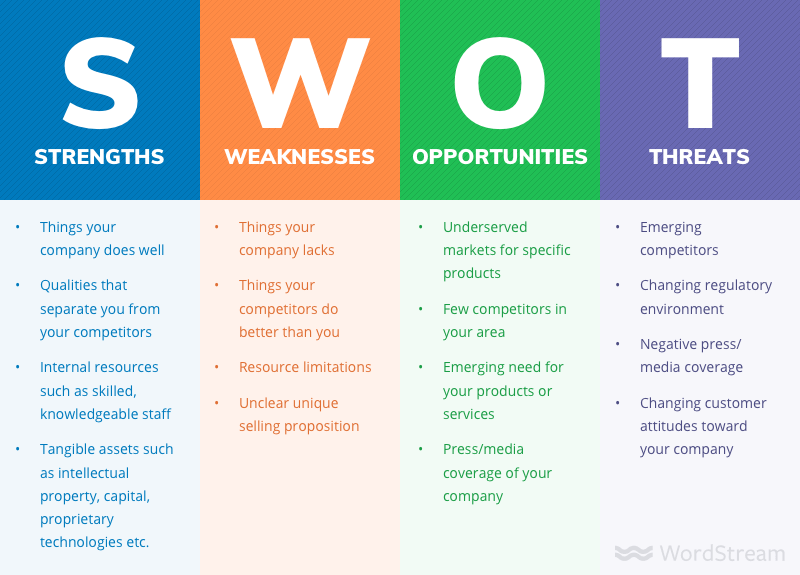 Image courtesy of Wordstream
Instead of covering how to build a detailed marketing plan in this post, which we’ve done in earlier posts, we focus on the why to encourage you through the efforts necessary to build a detailed marketing plan.
Here are 5 ways a detailed marketing plan helps your profits explode.
Why a detailed marketing plan helps explode your profits
A marketing plan provides focus
Clear direction is imperative to implementing a functional and successful marketing strategy, and a detailed marketing plan provides a focus that helps everyone within the firm integrate their strategies to achieve the overarching goals set up in the plan. Budgeting within the marketing plan ensures managers know all the costs involved in generating proposed revenues so other areas of the firm know their own budgets.
Market planning ensures that all the required activities take place, identifies necessary resources such as money and people, anticipates outcomes from specific activities, and builds a timeline that ensures the plan comes together when needed. We call these action plans as they’re very specific details around a certain element of the overall plan.
For instance, part of the overall detailed marketing plan might involve a product demonstration. The action plan details the date and all activities required for the event, such as a location, physical elements such as tables, chairs, and products to demo, people needed before, during, and after the event, and costs for each element required to pull off the event. A good action plan contains sufficient details that an employee handed the action plan implements it as envisioned.
A detailed marketing plan aids evaluation and informs decisions
A marketing plan helps allocate your marketing budget, see where money and other resources are spent, and analyze whether specific components of the plan are worth doing again in the future by determining which metrics to track.
Your marketing plan and individual action plans project the ROI (return on investment) anticipated on implementation, thus providing a means to evaluate performance. By understanding which actions resulted in profits and quantifying profits produces, managers have tools for accurate decision making related to future plans.
For instance, you created a piece of evergreen content designed as a lead magnet. By tracking the performance of the content as prospects move from awareness to purchase, and beyond to study CLV (customer lifetime value over the time a customer remains a customer) and AOV (average order value for each order) you determine the ROI of that content to determine whether to repeat this strategy and, if not, how you might improve performance over the next period with tactics featuring better performance.

Or, you might use information from sources such as Google Analytics to determine which channels generate the highest ROI or, as in this graph, represent orders with the highest average value. Hence. spending more money on email marketing (mail.google.com) and Facebook makes a lot of sense as a way to attract customers who spend more per purchase.
Information is power so plan to use information from implementing this period’s plan to make the next period’s plan even better.
A detailed marketing plan highlights where you need market research
A marketing plan forces you to conduct market research to fill the holes detected as you build your strategy. For instance, if you don’t know how the economy performs today, in real figures, you can’t anticipate how the economy might impact performance. If the economy is headed downward, you need strategies to adapt to the way consumers spend in a poor economy. A detailed marketing plan involves both research and modeling to predict changes over the coming period.
By performing an environmental scan, collecting internal data and plans, as well as modeling future performance, you learn information and statistics about your target audience, the consumer needs of the moment, and where your business fits in the current marketplace. Learning more about the internal and external environments forces you to think of how you pit yourself against your competition.
Conclusion
These are just a few reasons why a detailed marketing plan is vital for your business and helps leverage it against the competition. With a clear and direct plan, you soon discover other areas where your business benefits with better planning and implementation, which explodes your market performance. In unprecedented times such as with this worldwide pandemic, it has never been more important to ensure you have a strong marketing strategy and way to interact with your customers.
from Marketing – Business 2 Community https://ift.tt/38lL9e2
via IFTTT
Comments
Post a Comment