Pay-Per-Click (PPC) marketing can be one of the quickest and most effective ways to drive customers to your site.
But it can be hard to make money through PPC ads. It’s all too easy to make common mistakes that can wreck your campaign.
Luckily for you, I’ve got plenty of tips that can help.
And there’s one strategy I’ve borrowed from my business analyst friends, which I’m going to share with you today.
It’s called a SWOT analysis.
A SWOT analysis can help you see a different side to your PPC campaign and improve its performance in the process.
This article will help you carry out your own analysis and take your PPC campaigns to another level.
What is a SWOT Analysis?
A SWOT analysis is a corporate evaluation technique that can be used to assess anything from an entire company right down to a single PPC campaign.
So, what does SWOT stand for?
It stands for Strengths, Weaknesses, Opportunities, and Threats.
Strengths and weaknesses are internal factors, things you control. Opportunities and threats are external factors. These are happening in the market right now, whether you like it or not. You may not be able to change them, but you can react to them.
Typically, SWOT analysis is used at an operational level to help business leaders assess a company’s current position in the market and highlight areas for future growth.
It can also be used to assess your PPC campaigns. A SWOT analysis can show you how well your campaign is performing, what’s holding you back, and how you can improve.
Why Your Company Should Do SWOT Analysis for PPC Campaigns
A SWOT analysis should be considered essential if you don’t want your PPC campaigns to fail.
Too often, when brands try to optimize their PPC advertising, they look at their campaigns in isolation. They only analyze their own keywords, bids, and landing pages. But your PPC campaigns don’t exist in a vacuum.
You are competing with hundreds of other brands for the same cherished three or four spots.
A SWOT analysis will help you to understand external factors that may impact your PPC campaigns. Things like competitors, the economy, and the state of your industry can all affect the performance of your ads and the likelihood that someone will buy when they click them.
You’ll also identify new opportunities for your campaign. That could be doubling down on what you do well, or it could be fixing one of your weaknesses. When you lay out what’s working and what’s not, it’s much easier to put together a plan that involves more than just raising your bids.
Ultimately, it will help you to look at your PPC campaigns in a different way. Despite the wealth of advice out there on optimizing PPC campaigns, it’s easy to get stuck in a routine of researching keywords, testing new ad copy, and creating new landing pages.
There’s much more you can be doing to improve your campaigns, and a SWOT analysis will help you take your PPC campaigns to the next level.
How to Do a SWOT Analysis of Your PPC
All you need to do is sit down and brainstorm each of your campaign’s strengths, weaknesses, opportunities, and threats. They are typically displayed in a 2×2 grid.

But you can just make a list below each header if that’s easier.
It can help to have a goal in mind when starting your SWOT analysis.
By focusing on your PPC campaigns, you have already narrowed your focus, but can you get an even clearer picture of what you want to achieve?
Maybe you want to figure out why your PPC campaign isn’t driving as many sales as your Facebook ads, for instance. Or find ways to maximize what is already a profitable channel.
It’s best to do a SWOT analysis with more than one person. The more views and opinions you can capture, the more complete a picture you’ll be able to develop. You can brainstorm together or complete the analysis individually, coming together at the end to share your thoughts.
Finally, try to keep things as even as possible when brainstorming. If you have 10 strengths, find 10 weaknesses. Find a threat for every opportunity. You get the picture.
SWOT Analysis S: Strengths
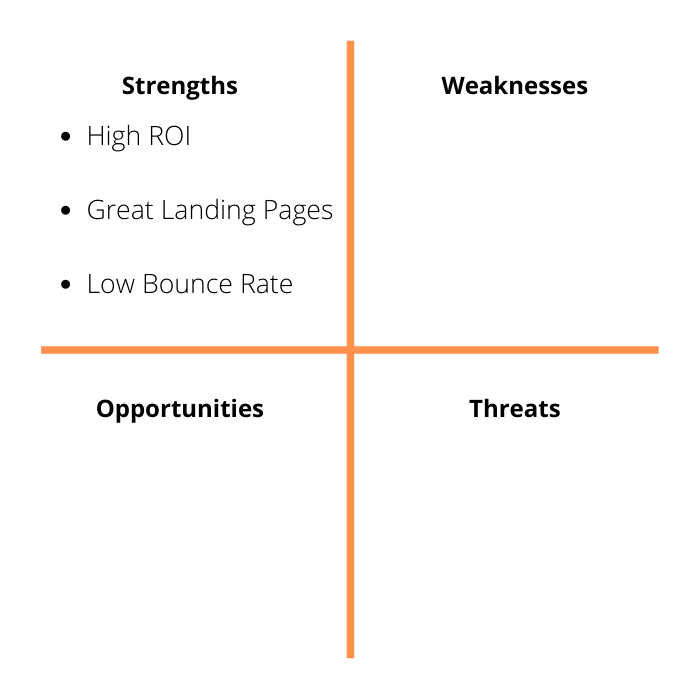
Start by making a list of all the strengths of your PPC campaign. Strengths are all the internal positive factors about your PPC efforts.
For instance, maybe you have an excellent ROI or a high Quality Score. Covering hundreds of relevant keywords could also be a strength, as could your CTR or bounce rate.
Think about the advantages you hold over the competition, too. That could be the PPC agency you partner with, for instance. It could even be the quality of your products or the strength of your brand. There’s no reason to limit your strengths to things that are specific to your PPC campaign.
Don’t be modest, here! Now’s the time to boast if ever there was one.
SWOT Analysis W: Weaknesses
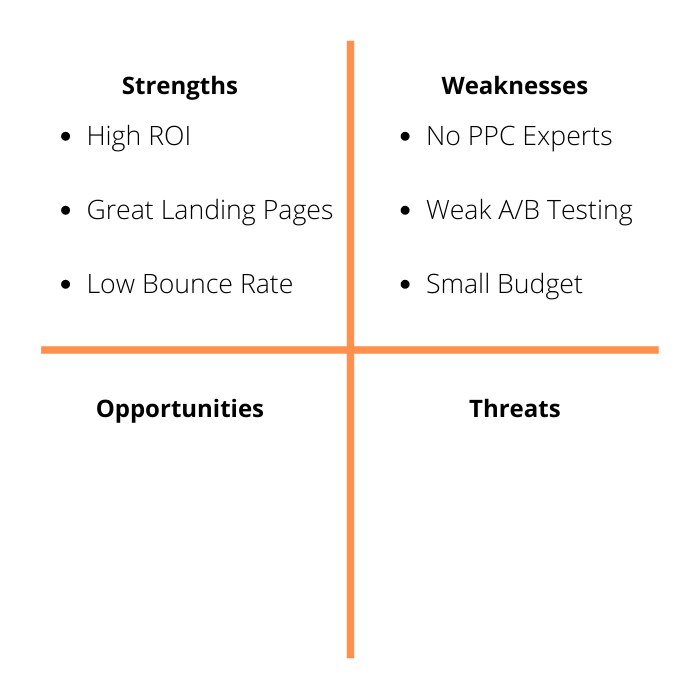
Next, examine your PPC campaign’s weaknesses. These are things you are in control of that are stopping you from increasing your ROI and generating more revenue. They could also be things your campaign currently lacks, like A/B testing.
But they could also be broader weaknesses like a small budget or a lack of PPC experts.
Remember to only include things you have control over in this category. Having a bigger, better-funded competitor is not a relevant weakness of your campaign. Operating in a very competitive market is, on the other hand. You can’t control your competitor, but you can choose not to compete. Or at least not compete directly.
When in doubt, look at your strengths section and think about the opposite.
SWOT Analysis O: Opportunities
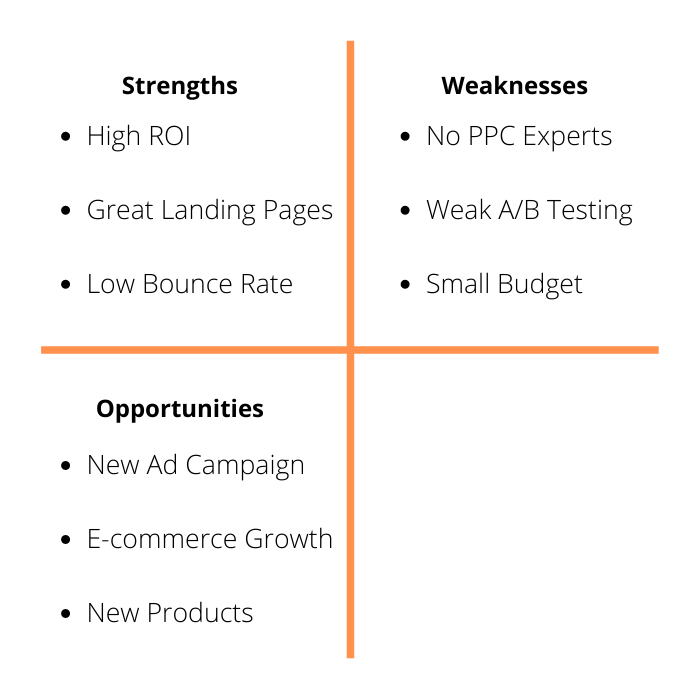
Now consider any external positive factors that could improve your PPC campaigns in the future. You could be launching a new advertising campaign, for instance, that would increase the demand for your product.
Maybe a competitor is on the verge of bankruptcy or is pivoting their business model.
Take into account the time frame of these opportunities. A new marketing campaign may only increase demand for a few months, whereas ongoing market growth (like the acceleration of e-commerce) may last for years.
Don’t forget to combine what you’ve done so far by including weaknesses that can be turned into strengths.
SWOT Analysis T: Threats
Finally, look at threats to your PPC campaign. These are also external factors that you have little to no control over. And this is where you’d list those bigger, better-funded competitors who are constantly outbidding you.
It’s not just your competitors you need to consider, however. What’s the market like for your current product? Are consumers shopping somewhere other than Google? Could anything change that would impact your success, like one of your employees taking a new job?
It can help to think about your company and your industry at a broader level, too. Does your product risk becoming obsolete, for instance? Or could changes to the market weaken demand for your offering?
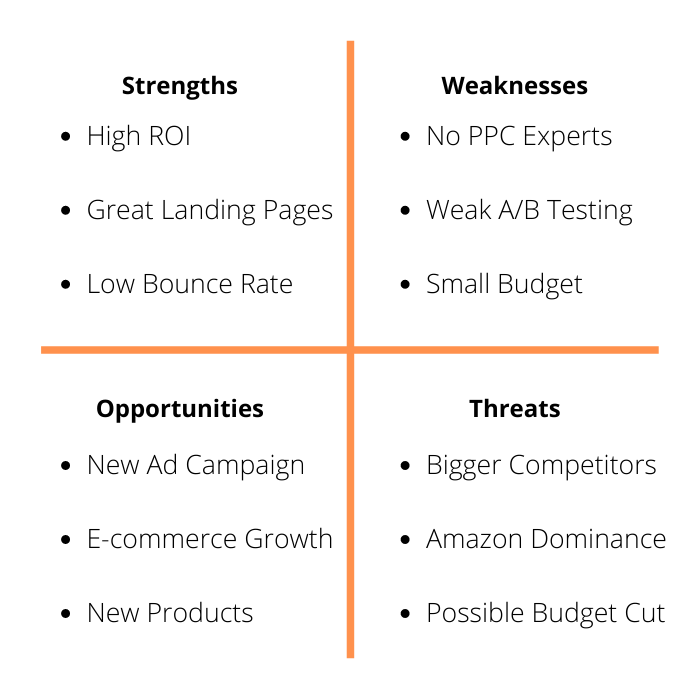
Visualizing and Displaying Your SWOT Analysis
There are several different methods to display your SWOT analysis.
As I have shown above, the most common format of a SWOT analysis is a 2×2 chart. This makes it easy to visualize your analysis as a whole, as every section is displayed in relation to each other.
But it’s not the only way you can display your SWOT analysis.
There are plenty of ways to make your analysis more digestible and visually engaging.
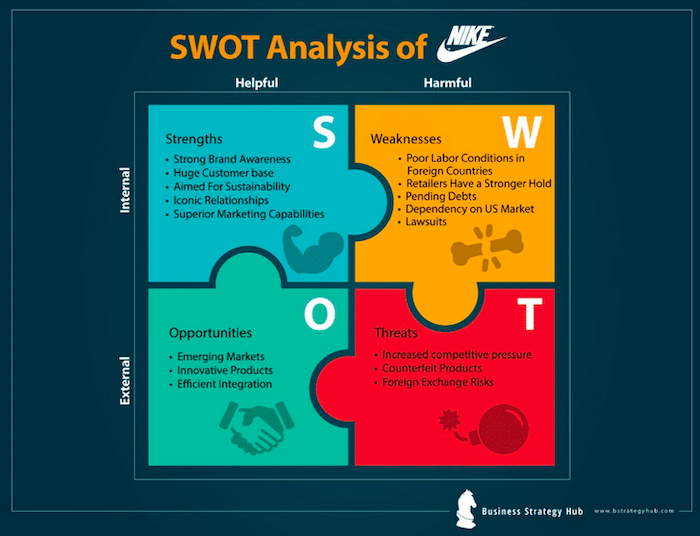
Check out this graphic analysis of a Nike SWOT by Business Strategy Hub.
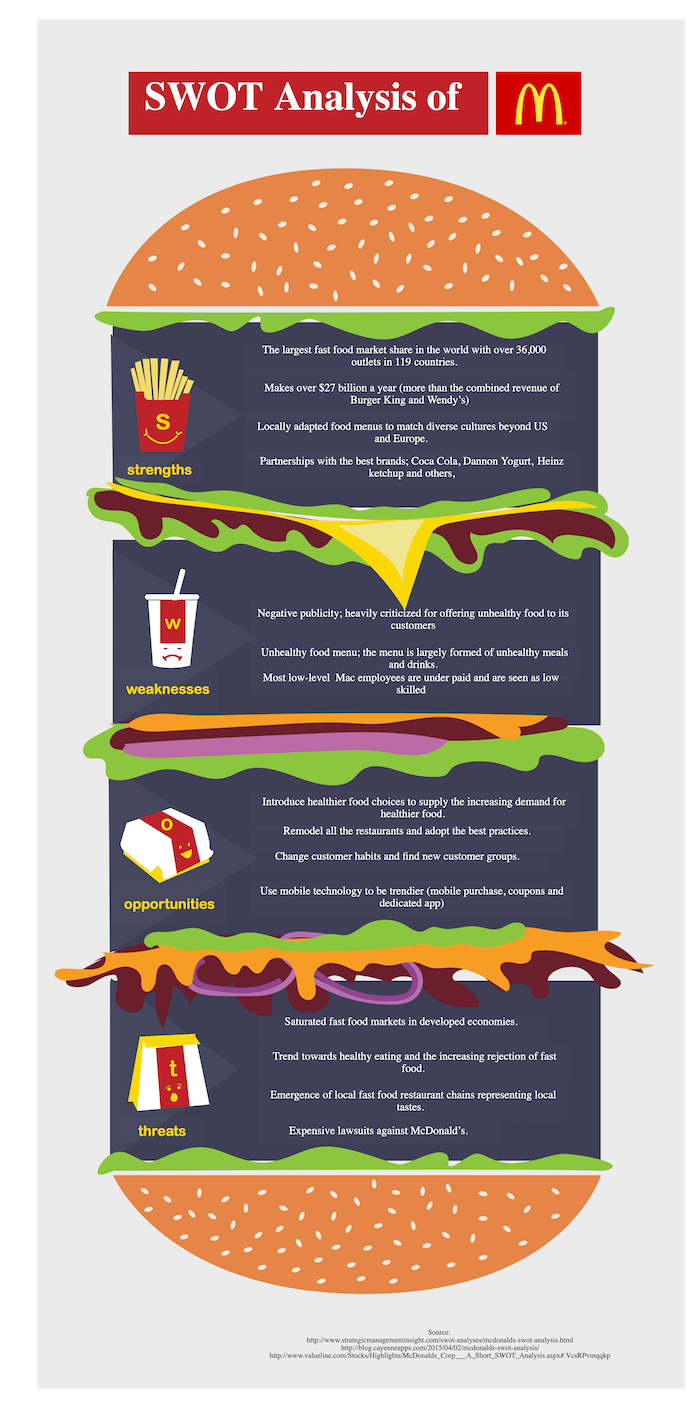
Or this creative McDonalds SWOT graphic by Creately.
If design isn’t your forte, Lucidchart has a SWOT analysis generator you can use instead.
Making Your SWOT Analysis Actionable
One problem with a SWOT is that it doesn’t produce actionable results. It only helps you understand where you currently are.
You need to make your analysis actionable.
Start by looking at the relationship between each section. For instance, ask yourself whether you can use your strengths to create new opportunities, or whether you can remove threats by improving your weaknesses.
Let’s start by looking at how you can turn your strengths into new opportunities. Basically, this means doing more of what you are good at. In the example above, we highlighted landing page creation as a strength.
You could turn this into an opportunity by creating more landing pages for your ad groups. Doing so could improve your quality score, decrease your bounce rate, and increase your conversion rate.
Next, identify how you can turn your weaknesses into strengths. Again, in the example above, I listed a lack of a dedicated PPC account manager as a weakness. Assuming you have the budget to hire a new employee, this is a pretty easy one to fix. Alternatively, you could work with a digital marketing consultant.
Now let’s look at opportunities. Is there any way you can capitalize on the opportunities you’ve identified? We listed e-commerce growth and new products as opportunities above. One option is to increase our budget to take advantage of the growth in e-commerce. Another would be to create new ads and landing pages for our new products.
Finally, look at the threats. You probably won’t be able to change any of these directly, but you figure out ways to mitigate the threats. For instance, if you have a larger competitor with a bigger budget, you can maximize your ROI as much as possible or target longer tail keywords.
Examples of SWOT Analysis for PPC Campaigns
Are you ready to start your own SWOT analysis? Hopefully, you can use my examples as a jumping-off point. But just in case you need more guidance, here are a couple of other examples of SWOT analysis for PPC campaigns.
The first is by White Shark Media.
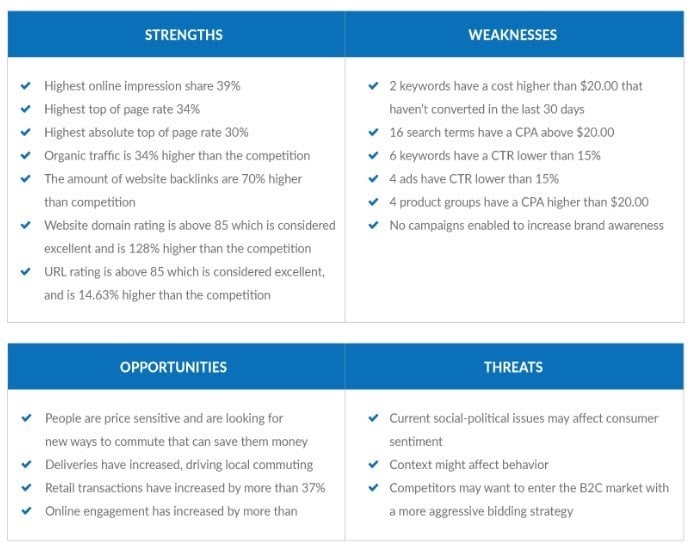
You can see they get very specific listing ad KPIs in both the strengths and weaknesses columns. They also do an excellent job of balancing strengths with weaknesses and opportunities with threats.
The second is by SEMrush and Hanapin Marketing.
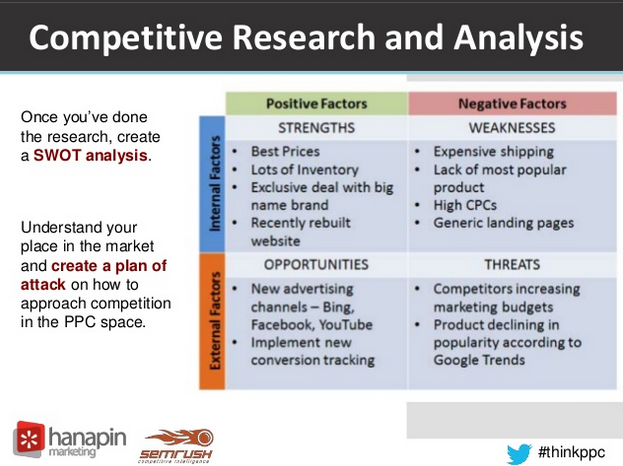
This is a much broader approach to PPC SWOT analysis, including things like product prices and availability. They also do a nice job of matching up strengths with weaknesses and opportunities with threats.
Conclusion
A SWOT analysis is a great way to get a different perspective on your PPC campaign. Remember, your campaigns don’t exist in a vacuum, and neither should your optimization efforts.
By thinking about your ads in the context of the broader market and economy, you can optimize your campaigns at a level your competitors can only dream of.
Why stop at creating new ad copy and running A/B tests when you can find out ways to capitalize on new consumer sentiment or shifts in the market.
What have you uncovered with your SWOT analysis? Let me know in the comments!
The post How to Do SWOT Analysis For PPC appeared first on Neil Patel.
from Blog – Neil Patel https://ift.tt/2IvEinC
via IFTTT
Comments
Post a Comment