
One of my favorite moments from The Simpsons is when the hilariously incompetent physician Dr. Nick burns down a building by mishandling a clearly marked chemical tank, and then exclaims, “Inflammable means flammable?! What a country!” via GIPHY “Incredible” is a word that can spark similar cognitive dissonance for marketers. Sure, it might technically be defined as “impossible to believe,” but if your content isn’t credible, would anyone describe it as incredible? Quite the opposite. In this business, incredible means credible. So let’s explore the cornerstones of creating credible, and thus truly incredible, content marketing.
6 Tips for Making Your B2B Content (Incredibly) Credible
Just as you can’t fake authenticity, you can’t fake credibility. This label is earned by brands over time by developing a trusted voice, showing up for your audience, and — above all — knowing what you’re talking about. With these being table stakes, today’s post examines how you can make sure this foundational credibility is showing up in the content marketing you create and distribute. Speaking of table stakes:1 — Don’t lie to your audience
We’re living in an age where misinformation runs rampant. Frankly, it can make the entire experience of being online very draining and exhausting. And while folks might have no choice but to put up with the zany Facebook post by their uncle, or the click-baity headline on Google News, they are less likely to tolerate it from companies they do business with. To be clear, I’m not under the impression that many B2B brands are out here attempting to flat-out fib to people. On this subject, I’ll make two points:- It’s all too easy to be untruthful with your audience unintentionally. If careless, marketers can fall into the same disinformation traps that plague many users of the web. Always fact-check and verify information before sharing it with your audience, and don’t make a habit of running with assumptions.
- Shying away from the truth isn’t much different from lying. It might not feel dishonest to downplay your solution’s weaknesses, or hide negative reviews, but will your customers feel the same?
2 — Gain credibility through association
One of the primary advantages of influencer marketing is that it allows brands to co-opt the credibility of respected experts and business leaders they partner with. When audiences see these individuals collaborating with a company, producing useful and enjoyable content together, it infuses an instant element of trust. It is not enough to simply activate influencer marketing, though — be strategic about it. Identify influencers who truly fit with your brand values, and aim for transparent authenticity in your engagements. In other words, beware of pay-to-play. As Lee Odden put it in an interview with Brand24: “Without clear alignment between the brand, influencer and audience, the program won’t resonate and everyone loses credibility.”3 — Be thoughtful about where your content is showing up
Your brand’s associations aren’t limited to “who”; there is also the matter of “where.” Credibility can be affected by the reputations of platforms where content is distributed, and by the other content that appears around it. In the social media sphere, Business Insider’s Digital Trust Report has found LinkedIn* to be the platform most trusted by users three years straight, and what’s especially interest to note is the dramatic drop-off Facebook has seen over this span: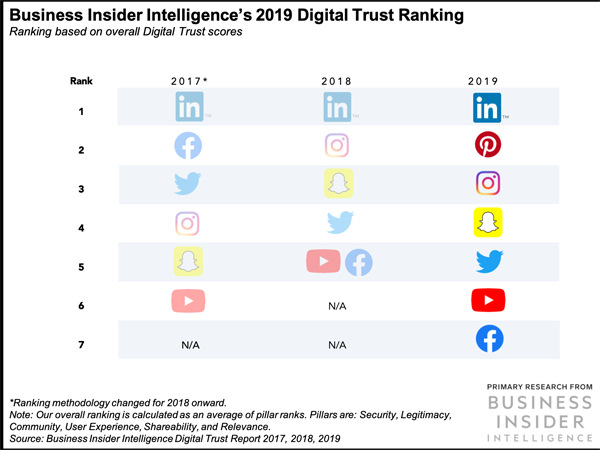 Nearly half of the respondents (47%) in Business Insider’s 2019 report said they think Facebook is “extremely likely” to show them deceptive content. I wrote on this blog recently about the B2B implications of the Facebook advertising boycott. This isn’t to say marketing on Facebook is a universal cred-killer, but it’s something that should increasingly be weighed in your decision-making. Any podcast your brand representatives appear on, or blogs they guest-post on, should also be vetted deeply. Just as you can gain credibility through association, you can also lose it.
4 — Put your brand’s purpose forward
I like to frame a company’s relationship with its purpose as that between the Earth and the Sun: Not so close that it’s constantly in your face, but always within view, and all of your marketing activities orbit around it. There are many benefits to being a purpose-driven brand, but the credibility factor is a big one. Credibility is built, in part, through consistency. Staying true to a clearly articulated guiding mission is one of the simplest ways to demonstrate consistency, even amidst rapidly changing conditions. Kim Davis of MarTech Today recently highlighted Deloitte’s seven marketing trends for 2021, which are geared toward “breaking out of our often defensive mindsets to more holistically — and authentically — meet human needs.” The first item on the list is purpose. And I might argue that the following six confidence-building touchstones – agility, human connections, trust, participation, fusion, talent transformation – all feed off it. Like planets orbiting the Sun.5 — Elevate the voices of your community
Companies aren’t credible. We can say they are, as a shorthand, but nobody actually finds a business entity trustworthy or dependable on its own. Credibility is driven by the people behind the brand, and by its advocates. Do all you can to showcase those individuals and continually reinforce their loyalty. Customers and employees come together to form your brand’s community. People see themselves in the reflection of the community, not the company logo or product features. So if you want to build credibility, lift those voices up. In the past, we’ve preached the value of user-generated content and employee advocacy. More recently, Cara Sloman wrote at Entrepreneur about the power of customer champions for trust and credibility.6 —Make the commitment and investment to do marketing well
At the end of the day, actions — and results — speak louder than words. Nothing is more credible than a piece of content that is downright GOOD – where it is clear that serious effort and expertise were channeled into creating something that would connect and make an impact. You can’t manufacture the credibility of ranking first in Google for a keyword you want to own, or building a large and engaged following on social media, or boasting heartfelt customer testimonials on your website. These things don’t come easily or automatically. And they’re never earned by taking the easy route. Jeff Bezos once said, “A brand for a company is like a reputation for a person. You earn reputation by trying to do hard things well.” Say what you will about the Amazon overlord, but no one can deny he’s got credibility on the subject of growing a modern business. Want help making your content marketing more credible AND incredible? Reach out to our team at TopRank Marketing. * LinkedIn Marketing Solutions is a TopRank Marketing clientThe post Incredible Content Marketing: 6 Tips for Infusing Credibility into B2B Content appeared first on B2B Marketing Blog - TopRank®.


from B2B Marketing Blog – TopRank® https://ift.tt/3lgurR7
via IFTTT
Comments
Post a Comment